
Electric airships 1883-1884
Article by James Herne
200 exhibitors showed their electricity generators, electric motors, batteries and battery components at the International Electricity Exhibition in Paris. The year? 1881. Not 1981. 1881.
19th century was full of inventions. Let’s look at some of them:
1859 – Planté invented the rechargeable battery. His invention lives on in the 12 V car batteries.
1873 – Siemens created the first commercially practical electricity generator. This worked also as an electric motor.
1879 – Siemens created a small electric locomotive that could tow 3 wagons each having seating places for 6 people.
1880 – Trouvé improved the efficiency of the Siemens motor.
1881 – Trouvé invented the electric tricycle and the electric outboard motor for a boat.
So, the first fun vehicles were made by Gustave Trouvé, and those vehicles were electric. Fossil coal was used for steam engines, but fossil oil was not in use yet.
As we can see from the 1881 caricature, King Steam and King Coal were anxious about the newborn, who had been named Electricity:
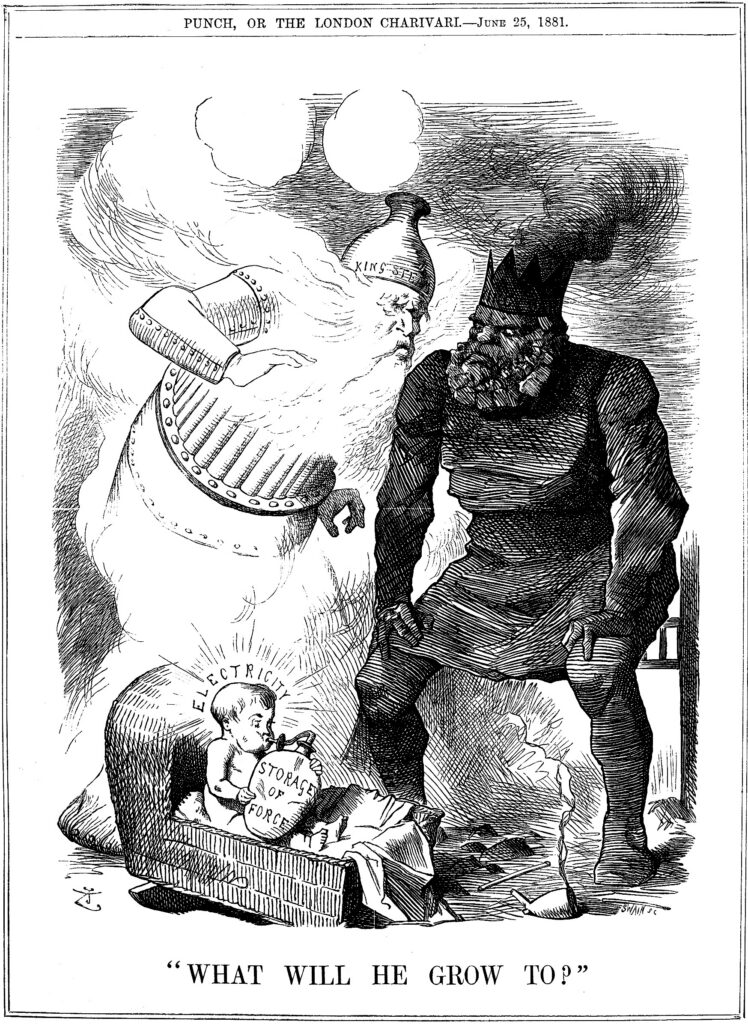
After seeing Trouvé’s electric boat on the Seine river in Paris on May 26, 1881, Gaston Tissandier got an idea to create an airship with electric motor. Tissandier had been flying hot-air balloons for over ten years and now without wasting time, on June 9, 1881, he registered a patent for “Application of Electricity to Aerial Navigation”. Tissandier had also started to construct a 4 m / 13 ft long scale model of his dream airship for the upcoming electricity exhibition.
The 1881 International Electricity Exhibition in Paris was the single most important event in human history to promote practical uses of electricity. The exhibition was open every day for 4 months. The shining stars of the event were the electric lamps and that’s the reason the exhibition was open from early in the morning until late in the evening.
“In the evening, the Exhibition will take on a fairy-like appearance; it will be a veritable dazzling display of lights. The public never tires of studying and admiring all the scientific marvels currently gathered in this monument, which one might call the temple of Electricity.” — ’La Nature’ magazine, 1881-08-20
The device for generating electricity was called a machine (by the way, ‘machine’ is a French word). When a source of electricity was connected to this machine, the machine was called a motor. In 1881, the main focus was on using the machines to generate electricity. At the exhibition, different machines were available: direct current machine with permanent magnets, alternating current machine with permanent magnets and direct current machine with electromagnets (alternating current motor with electromagnets was patented by Nikola Tesla a few years later, in 1888).
A unique exhibit at the exhibition was a model of the Tissandier’s future electric dirigible. This huge model was built in just 2 months. The model had rechargeable Planté batteries. The small electric motor, built by Trouvé, weighed just 8 oz / 220 grams.
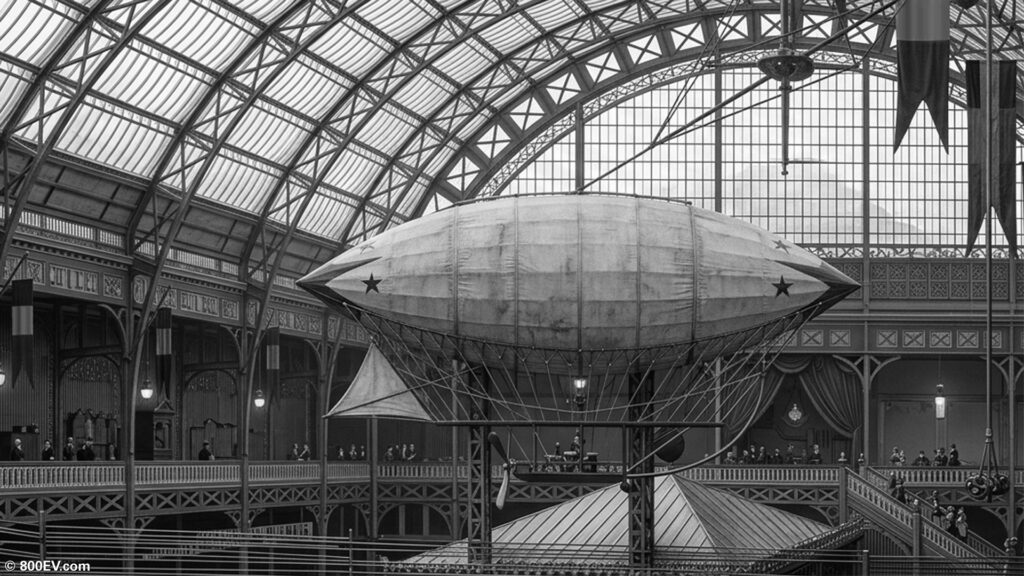
Tissandier calculated that an airship 10 times larger than the model would allow to carry several persons.
Victor Hugo, at the age of 79, after visiting the 1881 electricity exhibition, wrote:
“The day is near when the surface of the globe will be designed to store up solar heat; /-/ Transformed into electricity, this heat will be distributed everywhere, lighting the public streets at night, driving machines, pulling locomotives. /-/ The future will be splendid, just, liberating. It will be beautiful and good. You who are young will see these marvels. As for me, I shall not see them, but I know that they will come.”
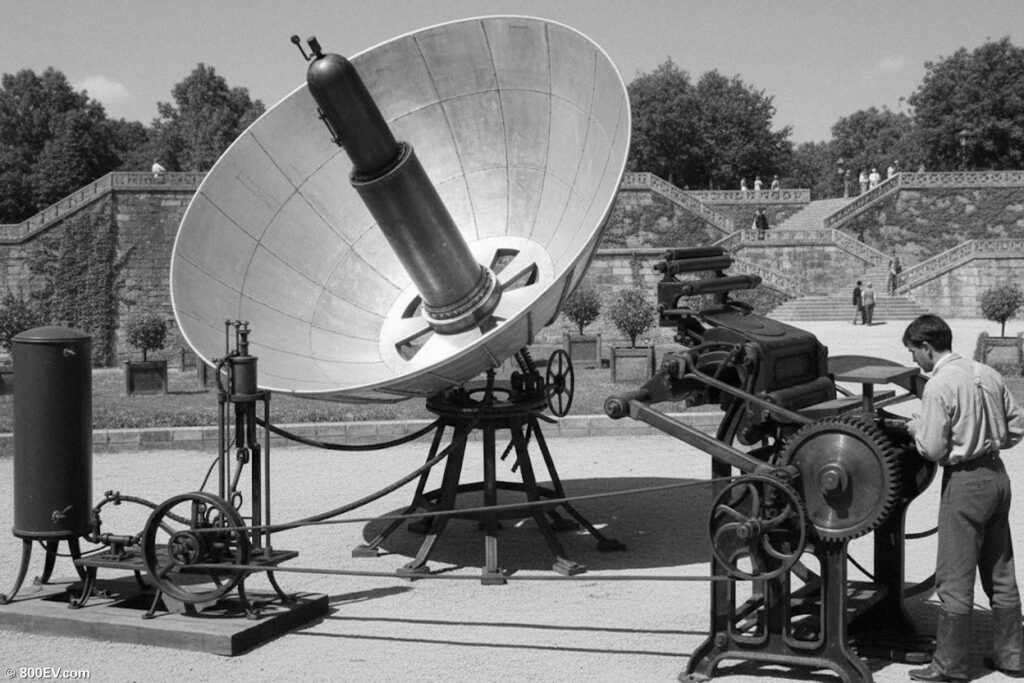
“Of all natural forces, the one that is least costly and most evenly distributed is the force of the wind, yet it is also the most neglected.” — ’La Nature’ magazine, 1883-07-14
Before the fossil oil era the engineers had just found ideas how to harness the energy from the sun and the wind. Even before the car was invented, an airship with electric motor was created!
The Tissandier brothers did not have time and money to construct a hangar so they had to build the large components of their airship outdoors. The size of the aerostat was defined by Tissandier’s plot in Paris. As we can see from the plan, the planned length of the airship was 27 m (88 ft):
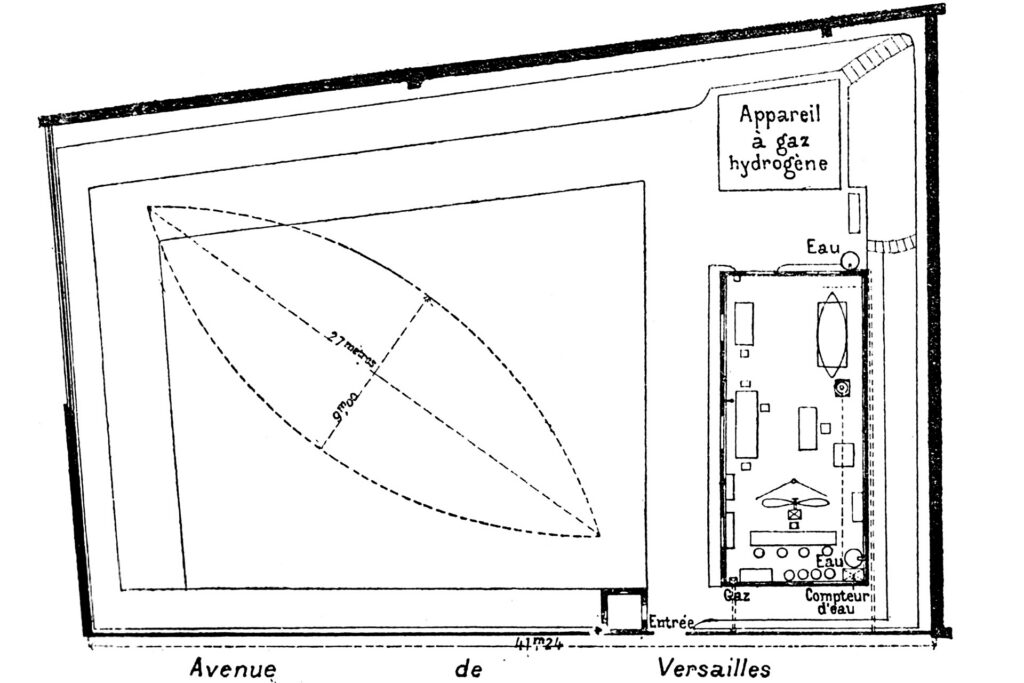
Gaston Tissandier concerned himself with building the electric motor, the battery and the apparatus for producing the hydrogen for the balloon, while his brother Albert Tissandier devoted himself to making the airship.
In 1882, Gaston Tissandier ordered the construction of a powerful and lightweight battery pack. At the time it meant that the around 5 kWh battery pack weighed 180 kg / 400 lb. Zinc and carbon plates were placed alternately inside a battery case made of ebonite. The current was generated by a liquid consisting of water, sulfuric acid (H2SO4), and potassium dichromate (K2Cr2O7).
On Gaston Tissandier’s order, a lightweight motor was constructed by Siemens in Paris. The new motor weighed 55 kg / 120 lb. At the battery pack’s maximum power of 1.8 kW (40 V, 45 A), the motor was able to output 1 kW. The efficiency of the motor was 55% (for comparison, the efficiency of modern electric motors is around 95%).
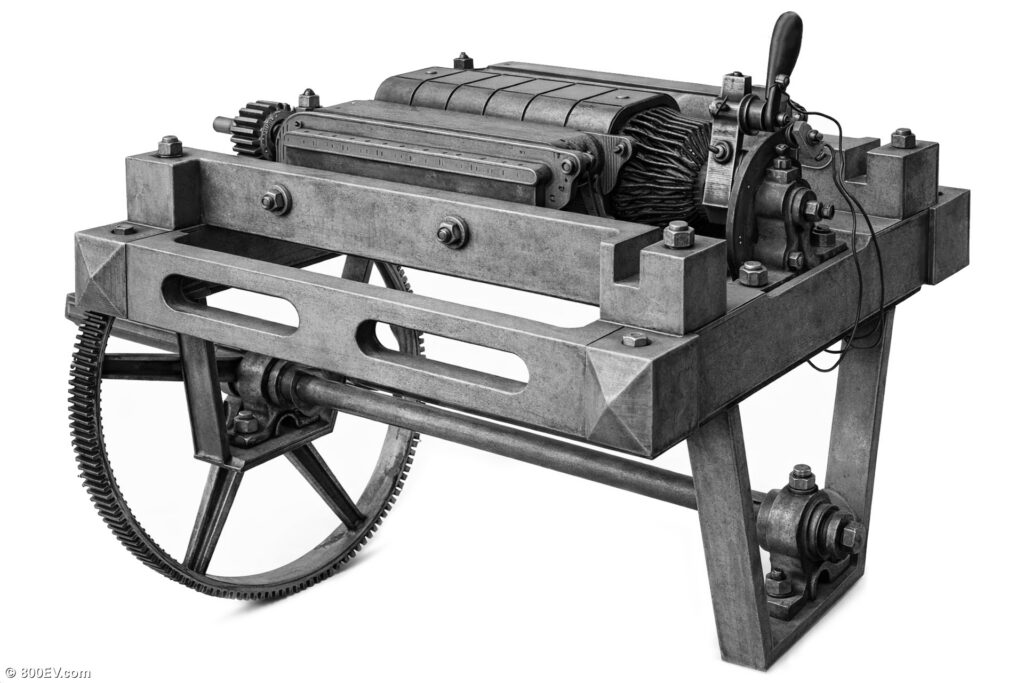
The motor drove the propeller through a 1:10 gear ratio. At a maximum engine speed of 1800 rpm, the propeller rotated at 180 rpm. The propeller, with a diameter of 2.85 m / 9.4 ft, weighed 7 kg / 15 lb.
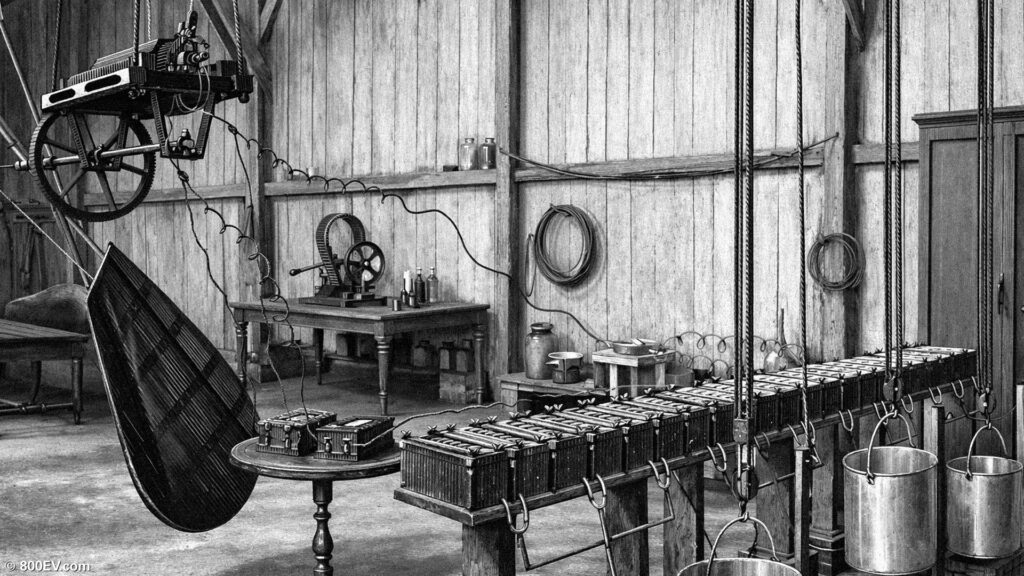
Initially, 24 separate batteries were used for testing, but then four 6-cell batteries were built to save space in the gondola. A rotary switch allowed the use of 6, 12, 18 or 24 battery cells, which gave 4 different propeller speeds.
Calculations showed that the top speed of the airship would not exceed 9 mph / 15 km/h. Wind speed is below that figure only in calm weather. In January 1883, Gaston Tissandier wrote in the ‘La Nature’ magazine that if it would be financially possible, they would construct a larger aerostat that could carry a 5 kW motor. French Army silently took note of this information.
When the Tissandier brothers’ airship got ready, it measured 28 m / 92 ft in length. The 1060 m3 / 37,500 ft3 balloon filled with hydrogen had a lifting force of 1250 kg / 2755 lb. For the first test flight to be easy, it was decided that the take-off weight should stay just 10 kg / 22 lb below the lifting force, at 1240 kg / 2733 lb. The weight of the airship was 704 kg / 1552 lb including the motor and the batteries. The brothers and the instruments they brought with them weighed a total of 150 kg / 331 lb. This left 386 kg / 851 lb for the throw-away ballast. Throw-away ballast was needed to regulate the ascent. For descent, some of the hydrogen would be released from the balloon.
On October 8, 1883, the important day arrived. Spectators gathered in Tissandier’s yard and watched as the first electrically powered airship took off. It was piloted by Gaston Tissandier (1843–1899) and Albert Tissandier (1839–1906).
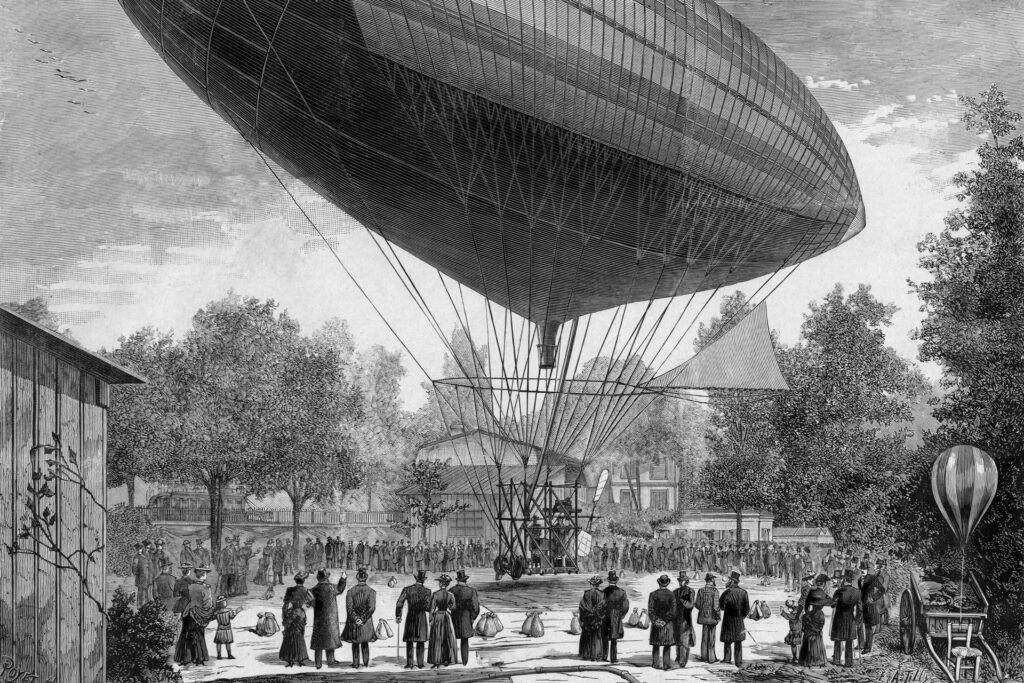
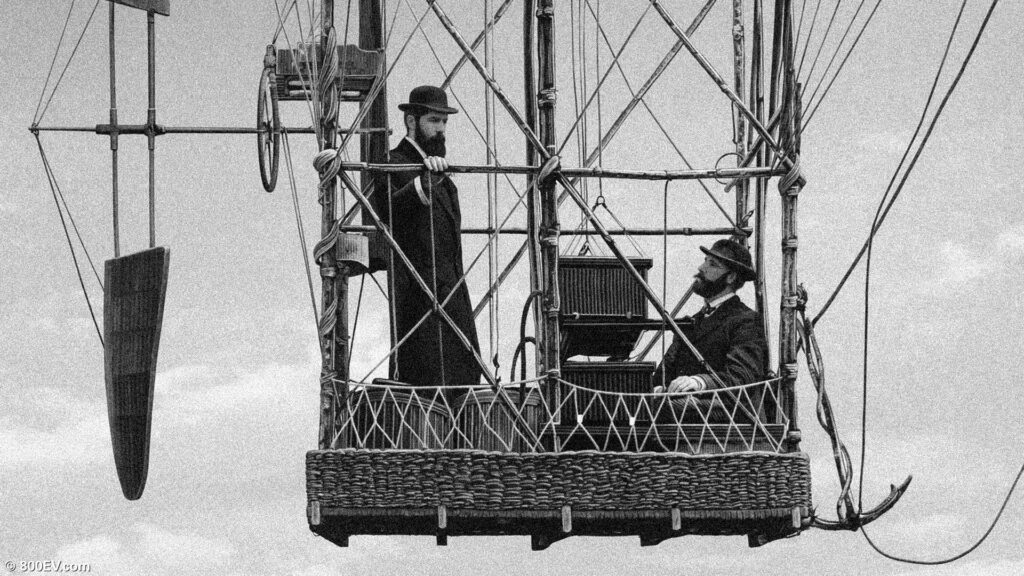
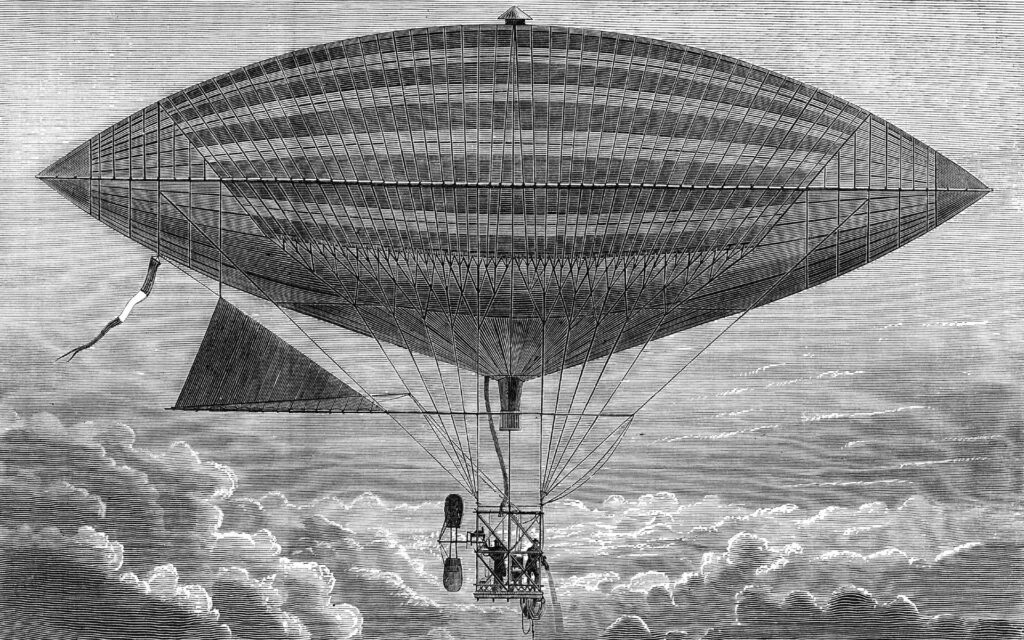
At the maximum propeller revolutions of 180 per minute the airship was able to hold against a wind of 7 mph / 10 km/h. The wind picked up and carried the airship along, making it impossible to return home. They landed outside Paris. It became abundantly clear that the airship needed more power.
French army captains Renard and Krebs closely observed what the Tissandier brothers had learned while building an electric airship. Based on this information, they secretly built an electric airship for the French army. The military balloon base Chalais-Meudon was located just 6.5 km (4 miles) from the Tissandier brothers workshop in Paris.
The battery components were kept secret by the army. It was only revealed that the battery was divided into four sections that could be connected in parallel for a longer flight or in series for a faster flight. At the maximum 8.2 kW from the battery pack, the motor power was 5.7 kW. Thus, the motor efficiency was 70%.
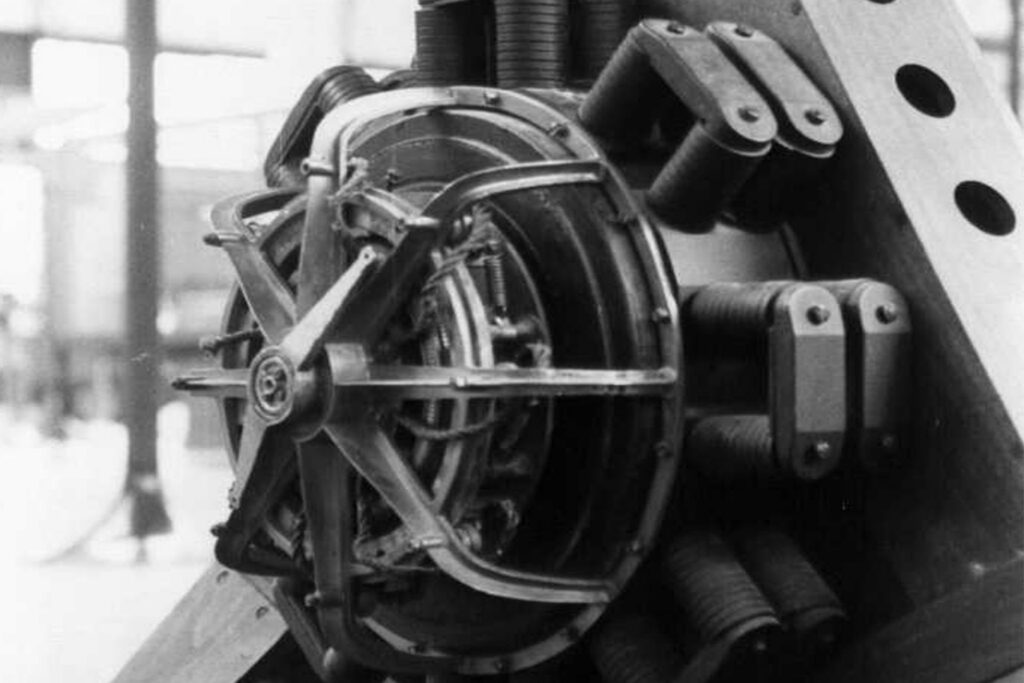
At maximum power, the propeller with 7 m / 23 ft diameter turned 46 revolutions per minute.
The Renard-Krebs airship was the first aircraft to have a propeller in the front. Even the first airplane, the Wright brothers’ 1903 Flyer didn’t have a propeller in the front.
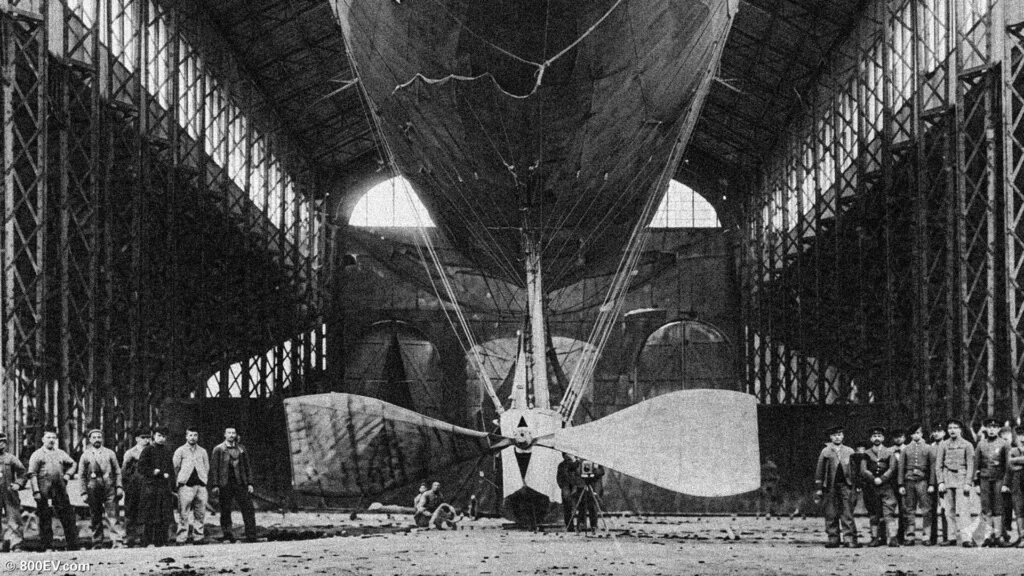
The Renard-Krebs airship ‘La France’ was almost twice as big as the Tissandier airship. The balloon was 50 m / 164 ft long. 1864 m3 / 66,000 ft3 of hydrogen provided a lifting force of around 2100 kg / 4600 lb.
On their maiden flight on August 8, 1884, Renard and Krebs were able to return to the base with their electric airship. After some maneuvers backwards and forwards, clumsily like a steamer, they landed near Hangar Y in Meudon, where the airship was built (the hangar still exists, see https://hangar-y.com). This was the first fully controlled flight in the history.
The ‘La France’ airship did multiple test flights in 1884-1885. The weak part of the Renard-Krebs design was that the propeller could be damaged in landing.
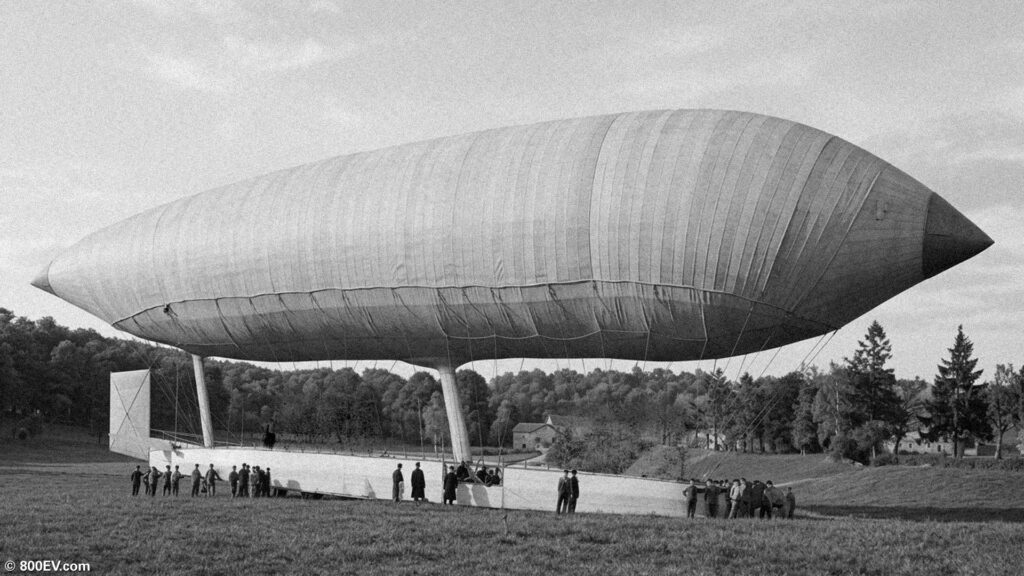
“Questions of personalities must disappear when the interests of science are at stake, and we will always applaud the success of our imitators.” —Gaston Tissandier (in his book “Mes ascensions, 1868-1888”)
The first part of the 1880s was a blessed moment in the history of humankind as the future looked electric. Then came the engines running on fossil fuel. 1885 was the year when the liquid fuel internal combustion engines from both Benz and Daimler-Maybach were ready for practical use.
To understand how wrong things went — writer Karl August Hindrey wrote in 1927 about fresh air that it “feels heavenly after the gasoline and smoke fumes of Paris”. A hundred years later, people are still creating excessive CO2 without a real reason.
The fossil fuel industry can be compared to clean electricity like a fishing trawler and a farmer who must compete on the same terms, while one simply exploits nature and the other does the hard work that is essential to save the planet for our descendants.
We should love Electricity, we should support the child that saves our world!